ECM Series: Hong Kong’s Follow-on Market Momentum
Sep 9, 2026

The ECM Series looks at trends in Hong Kong's equity capital market (ECM), their drivers, and what matters for issuers and investors in 2026 and beyond.

Key Takeaways
#1
Hong Kong recorded its second-highest H1 for follow-on issuance in 2026, with issuance reaching US$37.9 billion.
#2
Follow-on activity extended over a broad sector range, including Industrials, TMT and Healthcare.
#3
Equity-linked issuance reached an all-time H1 high as issuers made greater use of different deal structures, currencies and distribution channels.
#4
A quarter of eligible recent issuers returned to market after their post-IPO lock-ups period, demonstrating Hong Kong’s role beyond the initial listing.
An IPO may mark a company's entry into Hong Kong’s equity market, but it is only the beginning of its capital-raising journey.

Follow-on offerings post IPO allow companies and shareholders to return to the market after listing. They include primary transactions, in which listed companies issue new shares, and secondary sales by existing shareholders.

In Hong Kong, deep liquidity and efficient execution enable issuers to raise capital at scale, respond quickly to funding needs and reach a broad investor base. Follow-on issuance reached US$37.9 billion in H1 2026, according to Dealogic – up 17.7% year-on-year.


That scale was also visible at the level of individual transactions. Eleven US$1 billion-plus follow-ons priced in H1 2026, more than twice the H1 2025 total.

But scale is only part of the story. Just as telling is the breadth of this activity: the range of sectors raising capital, the mix of structures issuers are using, and the speed with which recently listed companies are coming back to the market.

Activity across sectors
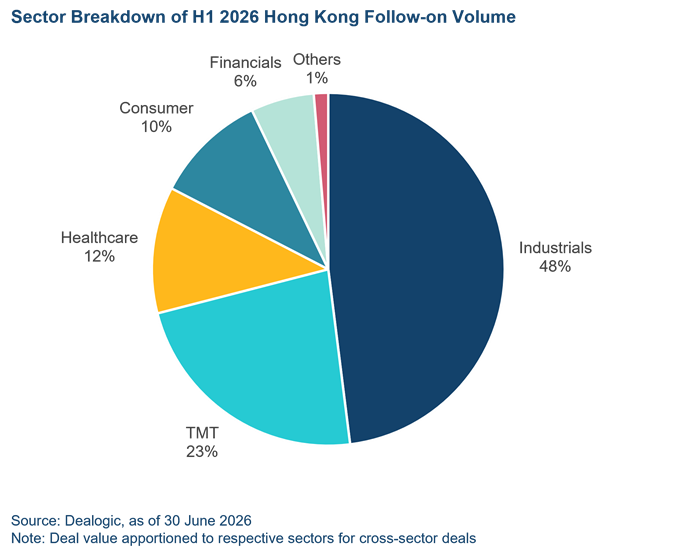
The sector mix of Hong Kong’s follow-on market reflects the breadth of capital needs extending across industrial capacity, technology development and research-intensive healthcare.

Industrials accounted for 48% of follow-on volume in H1 2026 and produced six of the 10 largest deals, including CATL’s US$5.0 billion primary placement and convertible bonds of around US$1.5 billion each from Zijin Mining and China Hongqiao.

Spanning batteries, base and precious metals, and aluminium, these transactions highlight the capital required for EVs, advanced manufacturing and other emerging industries.

TMT companies contributed a further 23% of follow-on volume through primary capital raises and secondary share sales, while Healthcare companies accounted for 12% of volume, with Chapter 18A issuers representing 15 of the sector’s 31 deals.
 

The sector mix continues to evolve into H2 2026, with major transactions concentrated in TMT.

In July, recently listed AI companies Zhipu, MiniMax and Iluvatar CoreX returned to the market through primary or combined offerings. Alibaba followed with an HK$80 billion share placement, the third-largest follow-on globally in 2026 as of end-August, committing all net proceeds to its AI capabilities.

Enabling speed and flexibility

Supporting this activity are faster execution, favourable Hong Kong dollar and renminbi funding costs, and demand from a diversified global investor base.

Settlement periods for primary placements have shortened as issuers and their advisors work closely with the Exchange to accelerate the process, and alongside this, issuers are making use of a broader range of instruments, currencies and distribution options.  

In H1 2026, shorter-tenor structures and favourable funding costs in Hong Kong dollars and renminbi encouraged greater use of equity-linked instruments, helping issuance reach a record US$18.3 billion – nearly half of all follow-on volume during this period.


Issuers are combining equity and equity-linked products to raise capital from different investor groups while managing financing costs and potential dilution. MMG's June 2026 US$1.6 billion combined primary placement and convertible bond illustrates this flexibility.

Distribution patterns are evolving as well. More large deals from Hong Kong issuers are pricing without a US tranche, with 24 ‘Reg S only’ convertible bond deals in H1 2026, a 60% increase year-on-year.

These transactions were marketed to investors outside the US, reflecting depth of demand across Hong Kong, Asia and other international markets.


A market that supports the full fundraising cycle
The recent pace and scale of Hong Kong follow-on issuance is underpinned by robust market conditions.

Hong Kong’s cash market average daily turnover reached HK$283 billion in H1 2026, up 17.8% year-on-year and more than double the 2024 level, according to HKEX data.

For eligible companies, subsequent inclusion in Stock Connect can also broaden access to Mainland Chinese investors and contribute to the aftermarket liquidity available for future follow-on issuance.

Aftermarket performance provides further support: nearly 90% of H1 2026 IPOs in the city traded up on their first day and delivered an average 46% one-month return.

Together, deep liquidity and strong aftermarket performance support Hong Kong issuers' continued fundraising, and they are returning sooner and with bigger needs, from seeking funding to lead the next phase of AI to exploring the next stage of clinical development.

For companies with more to build, and the investors looking to back them, this is where growth finds its capital.