Building Connected Product Ecosystems that Drive Liquidity
blog_Brian_100x100
HKEX Head of Equities Product Development
Dec 12, 2025
HKEX is building connected product ecosystems to grow market liquidity and create flywheel effects that strengthen Hong Kong’s role as an international financial centre.

Liquidity in Hong Kong’s capital markets has grown substantially over the past decade. Average daily turnover (ADT) in its cash equities market rose from HK$69.5 billion in 2014 to HK$256.4 billion for the first nine months of 2025, reaching a record HK$621.0 billion on April 7, 2025.

HKEX has played a key role in driving this growth by developing connected, multi-asset product ecosystems. These ecosystems are now being leveraged as global capital flows shift to Asia and China’s story of growth and integration with the world economy accelerates.

The growth of HKEX’s technology issuer ecosystem and the development of a multi-asset product ecosystem around it exemplifies this strategic approach.

HKEX has implemented significant listing rule changes to meet robust investor appetite for new, tech-driven growth opportunities and attracted a surge of listings in Hong Kong by technology companies.

Since the introduction of new listing regimes in 2018, 393 companies in new economy sectors including technology, internet, e-commerce and biotech have listed in Hong Kong, raising almost HK$3 trillion as of Sept. 30, 2025.

This influx of new listings has changed the face of Hong Kong’s markets, with ‘new economy’ companies’ share of Main Board market capitalisation growing from 16% in 2017 to around 30% as of Sept. 30, 2025. Trading activity has also shifted, with TMT issuers alone accounting for 40% of ADT in Q3 2025, according to Bloomberg data.

As this issuer base has evolved, so has the market’s range of products and benchmarks. For example, in July 2020, the Hang Seng TECH Index (HSTECH) was launched as a benchmark tracking large-cap stocks for Hong Kong’s technology issuer ecosystem in Hong Kong.

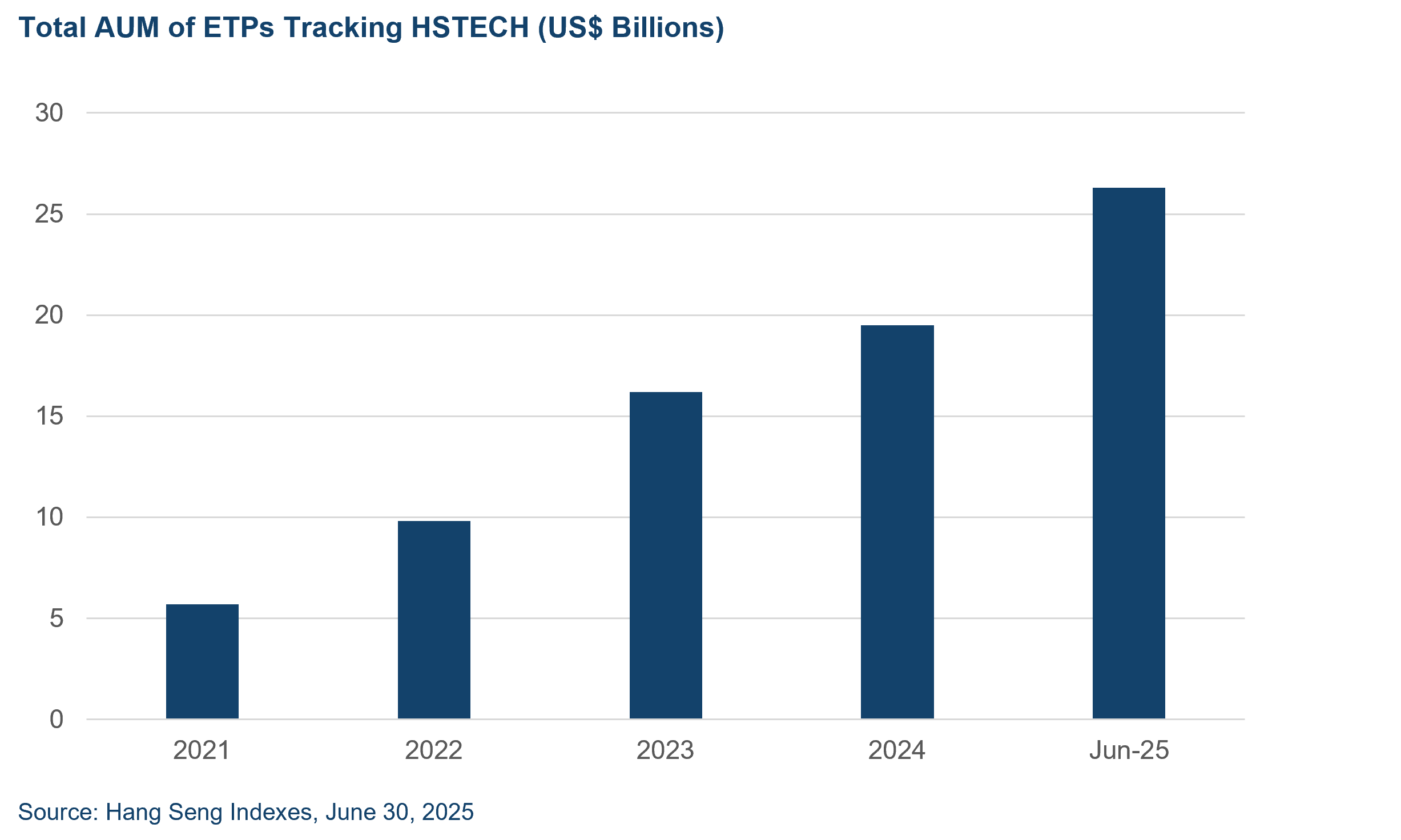
Over time, HKEX has developed a rich shelf of products around our tech ecosystem. The number of ETFs linked to the tech index benchmark and their total AUM has grown to 29 and US$26.3 billion, respectively, by the end of June 2025.
 

In addition to ETFs, HKEX has introduced a range of futures and options contracts to our tech product ecosystem that offer hedging and risk management tools.

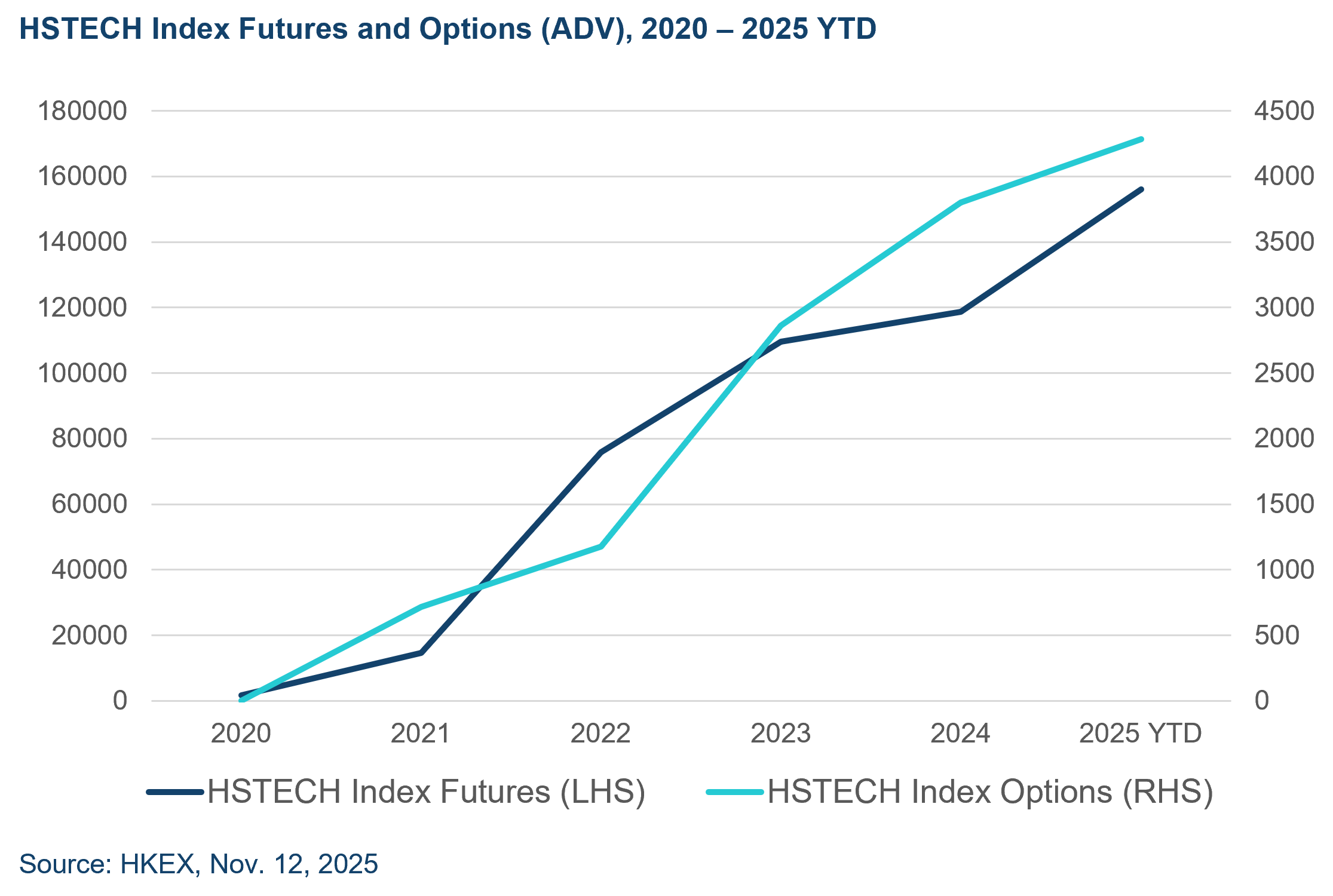
Futures average daily volume (ADV) has grown from 1,754 contracts in 2020 to over 156,000 YTD as of Nov. 12, 2025, and ADV for options rose from 719 contracts in 2021 to 4,282 YTD as of the same date. In recent months, momentum in options trading around the HSTECH benchmark has grown significantly with ADV of 9,874 in August, 15,499 in September and 26,098 in October  far exceeding the YTD average.


By building a suite of products around the tech ecosystem that are designed to interact together, HKEX has created conditions that support active trading across cash and derivatives markets.

And as this product ecosystem has grown, the market capitalisation of HSTECH Index constituents has grown from HK$1.2 trillion in 2020 to over HK$3.8 trillion as of June 2025.


Enhancing the market

But while the wide-ranging product innovation discussed above is essential to increasing market vibrancy, having efficient market infrastructure is equally important.

To that end, HKEX has implemented several enhancements, including increased position limits in December 2023 and July 2025 to allow for increased usage, Severe Weather Trading in September 2024 to keep markets open whatever the weather and refined tick sizes for the cash market in August 2025 to lower trading costs.

The result of all these enhancements is smoother trading and tighter spreads, which is beneficial for all our market participants and has helped support the high levels of trading activity recorded recently.


Building a flywheel effect

There’s a phrase in markets that “liquidity begets liquidity”: once trading activity takes root, it naturally draws more participants.

Yet this concept overlooks the deep thinking, careful design, challenging market enhancements and extensive coordination with market participants required to build the connected product and trading ecosystems that truly drive liquidity.

It takes time and effort to create the conditions for trading activity to thrive. But, like the turning of an aircraft’s flywheel engine, each propeller spin adds momentum until it accumulates into a self-sustaining flywheel effect that provides the thrust needed to take flight.

In a similar way, the steady development of our tech product ecosystem over the past five years has demonstrated how a “liquidity flywheel effect” can help trading activity soar – and we are intent on building out even more connected product ecosystems.


We have just added to our tech product shelf with the launch of the HKEX Tech 100 Index, which captures 100 large and mid-cap Hong Kong-listed technology companies that are eligible for Southbound Stock Connect. This new benchmark – our first Hong Kong equity index – enriches the tech product ecosystem and provides a foundation for future ETFs, derivatives and structured products, reinforcing the liquidity flywheel effect across our markets.

We have also added further depth to our product ecosystem with the launch of Hang Seng Biotech Index (HSBIO) Futures in November 2025.

With a diverse base of biotech issuers, the well-established Hang Seng Biotech Index and five ETFs tracking the index that have seen AUM surge from HK$1.5 billion in March 2021 to HK$11.0 billion in September 2025, the momentum is there.

Introducing a futures product propels the flywheel further; providing direct tools for hedging and risk management which expand choice for market participants and can, over time, drive activity across our markets.

Adding this, and many other connected product ecosystems, to our markets will position Hong Kong for an exceptional opportunity: namely, to take on the role of the leading capital market in the region as the axis of the world economy and global capital flows shifts to Asia. So, it’s an exciting time for Hong Kong, and I look forward to exploring our developing product ecosystems and dynamic flywheel effects across the markets in my next article.